
Nodosaur
Borealopelta markmitchelli
"Northern shield of Mark Mitchell"
Sobre esta espécie
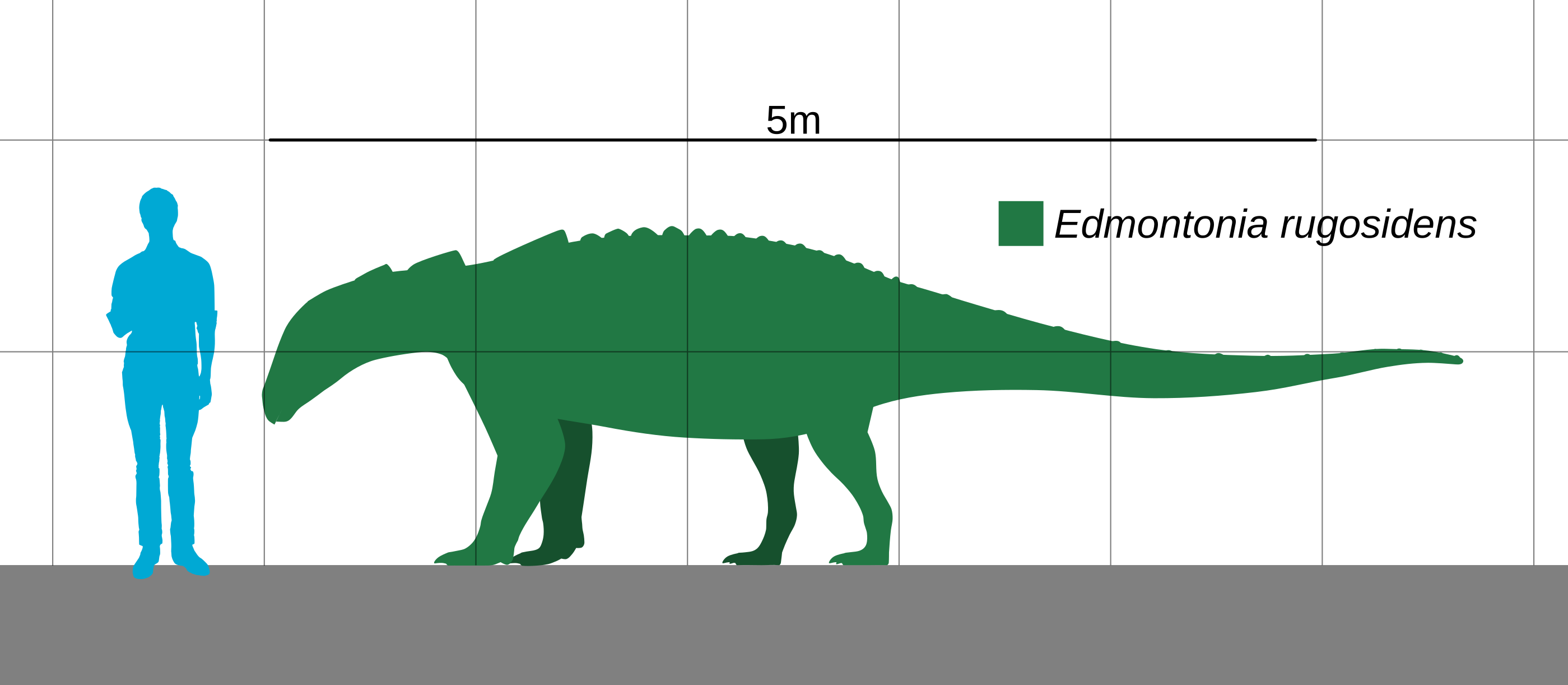
Borealopelta markmitchelli is considered the best-preserved dinosaur ever discovered. Found in 2011 at an oil sands mine in Alberta, Canada, the specimen retained skin, osteoderms in life position, and even stomach contents. Around 5.5 meters long and 1.3 metric tons, it was a heavily armored quadrupedal nodosaurid, with large parascapular spines and countershaded coloration suggesting intense predation pressure despite its armor. It was described by Caleb Brown and colleagues in 2017.
Geological formation & environment
The Clearwater Formation (Wabiskaw Member) is a Lower Cretaceous stratigraphic unit (Aptian-Albian, about 110-112 Ma) of the Western Canada Sedimentary Basin in northeastern Alberta. Deposited in a shallow marine and deltaic environment, the formation is economically important as an oil sands reservoir, with Suncor Energy's Millennium Mine being the exact discovery site of the Borealopelta holotype. The specimen was preserved in marine sediments, indicating the carcass was transported by a river to the interior sea before burial. The formation also preserves marine invertebrates providing precise biostratigraphic dating.
Image gallery


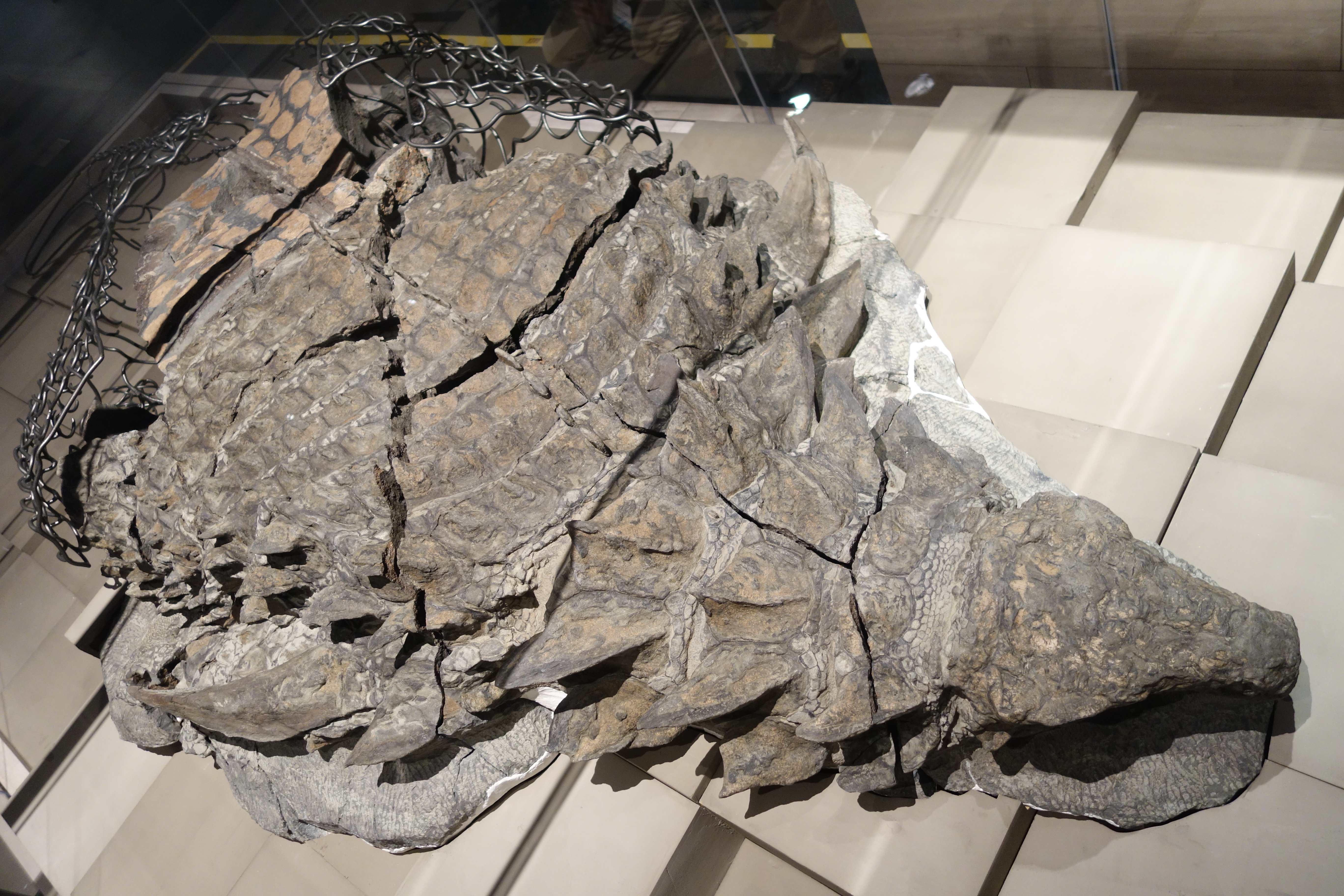


Holotype TMP 2011.033.0001 of Borealopelta markmitchelli on display at the Royal Tyrrell Museum, retaining osteoderms in life position and skin remnants.
Royal Tyrrell Museum / Wikimedia Commons — CC BY-SA 4.0
Ecology and behavior
Habitat
Borealopelta inhabited the coastal plains and riparian forests of interior North America in the Aptian-Albian, about 110-112 million years ago. The region was bordered by the expanding Western Interior Seaway, with a warm and humid climate. The local paleoenvironment was dominated by conifers like Athrotaxites and Elatides, with understories of ferns and cycads. The holotype specimen was preserved in marine sediments, indicating the animal was washed out by a river or flood into the sea, where it sank and was rapidly buried.
Feeding
A selective herbivore, Borealopelta primarily consumed ferns (over 88% of stomach contents), despite the environment being dominated by conifers. This selectivity is evidenced by direct botanical analysis of the preserved stomach contents published by Brown et al. (2020). The animal likely grazed at ground level, keeping its head low to access small-growing ferns. Gastrolith consumption suggested digestive aid for fibrous plant material.
Behavior and senses
The countershaded coloration pattern inferred for Borealopelta is highly unusual for a 1.3-tonne animal with complete body armor. This camouflage suggests the nodosaurid faced predation pressure intense enough to select for concealment behaviors and features. Large predators in the Canadian Aptian included large theropods whose records in the region are still scarce. Solitary behavior is inferred, with no evidence of gregarious behavior.
Physiology and growth
Like all ankylosaurs, Borealopelta was ectothermic or mesothermic, with intermediate metabolism between modern reptiles and mammals. The extensive armor (osteoderms with keratinous sheaths) increased body density to approximately 1.1 kg/L, above the average for unarmored dinosaurs. Growth was relatively slow compared to theropods of similar size. Analysis of gastrolith mass and stomach volume indicates digestive capacity compatible with selective herbivory of fibrous material.
Paleogeography
Continental configuration

Ron Blakey · CC BY 3.0 · Cretáceous, ~90 Ma
Fóssil sites

Wikimedia Commons — CC BY-SA 4.0
During the Aptiano-Albiano (~112–110 Ma), Borealopelta markmitchelli inhabited Laramidia, the western half of present-day North America, separated from the east by the Western Interior Seaway, a shallow sea dividing the continent. The continents were in very different positions: India was drifting toward Asia, Antarctica was still connected to Australia, and South America was an isolated island.
Inventário de Ossos
The holotype TMP 2011.033.0001 preserves the animal from snout to hips, without the tail. It is the most complete and best three-dimensionally preserved nodosaurid ever found, retaining skin, osteoderms with keratinous sheaths, stomach contents, and possible organic pigments.
Found elements
Inferred elements
Scientific Literature
15 papers in chronological order — from the original description to recent research.
An Exceptionally Preserved Three-Dimensional Armored Dinosaur Reveals Insights into Coloration and Cretaceous Predator-Prey Dynamics
Brown, C.M., Henderson, D.M., Vinther, J., Fletcher, I., Sistiaga, A., Herrera, J. & Summons, R.E. · Current Biology
Founding paper describing holotype TMP 2011.033.0001 as the world's best-preserved nodosaurid. Brown and colleagues conduct chemical analysis of organic pigments preserved in skin and osteoderms, identifying melanin distributed in a countershading pattern: dark dorsum, lighter underside. Countershading, common in prey species facing large predators, is unexpected in a 1.3-tonne fully armored animal. The authors conclude that predation pressure in the Albian fauna was intense enough to select for camouflage even in an armored megaherbivore. Phylogenetic analysis places the species within Nodosauridae, close to Pawpawsaurus and Europelta.
An exceptionally preserved armored dinosaur reveals the morphology and allometry of osteoderms and their horny epidermal coverings
Brown, C.M. · PeerJ
Detailed osteological and morphometric study of 172 osteoderms from the Borealopelta markmitchelli holotype. Brown quantifies the size, shape, and proportions of both the bony osteoderms and the keratinous sheaths covering them, exceptionally preserved. Allometric analysis shows that spine height is positively allometric relative to basal osteoderm dimensions. The work establishes that the keratinous sheaths substantially increased the apparent size of each defensive structure, implying the animal's actual armor was even more imposing than isolated bones suggest. Detailed anatomical descriptions and high-resolution photographs make this the primary reference for nodosaurid osteoderm morphology.
Dietary palaeoecology of an Early Cretaceous armoured dinosaur (Ornithischia; Nodosauridae) based on floral analysis of stomach contents
Brown, C.M., Greenwood, D.R., Kalyniuk, J.E., Braman, D.R., Henderson, D.M., Greenwood, C.L. & Basinger, J.F. · Royal Society Open Science
Paleoecological analysis of the exceptionally preserved stomach contents of the Borealopelta markmitchelli holotype. Brown and colleagues identify that the animal's last meal consisted of more than 88% fern leaf tissue, with minor amounts of cycads and conifers. Paradoxically, the local paleoenvironment was dominated by conifers (44-70% of vegetation). This indicates selective feeding: the animal preferred ferns even when they were relatively scarce. The authors also recover gastrolith fragments, identify charcoal, and propose the animal died in summer or early autumn based on plant phenology. This is the first detailed stomach content study of a large ornithischian dinosaur.
The Albian vegetation of central Alberta as a food source for the nodosaurid Borealopelta markmitchelli
Kalyniuk, J.E., West, C.K., Greenwood, D.R., Basinger, J.F. & Brown, C.M. · Palaeogeography, Palaeoclimatology, Palaeoecology
Study of Albian vegetation in Alberta as paleoecological context for understanding the diet of Borealopelta markmitchelli. Kalyniuk and colleagues analyze macroflora census collections from five localities in the Gates Formation (Grande Cache Member), revealing a conifer-dominated landscape with Athrotaxites, Elatides, and Pityocladus (44-70%), with ferns as subordinate elements. Comparing available flora with Borealopelta stomach contents, the authors confirm the animal practiced selective feeding, consuming ferns in much greater proportion than their environmental abundance. The work contributes to understanding niche partitioning among large Albian herbivores of Canada.

The Basal Nodosaurid Ankylosaur Europelta carbonensis n. gen., n. sp. from the Lower Cretaceous (Lower Albian) Escucha Formation of Northeastern Spain
Kirkland, J.I., Alcalá, L., Loewen, M.A., Espílez, E., Mampel, L. & Wiersma, J.P. · PLOS ONE
Description of Europelta carbonensis, a new basal nodosaurid from the Lower Albian of Spain. Kirkland and colleagues' phylogenetic analysis is highly relevant to Borealopelta because it defines the topology of Albian nodosaurids: Europelta appears as sister group to a clade of Late Cretaceous European nodosaurids, while Pawpawsaurus and related taxa form the immediate outgroup of Borealopelta. The work includes the most detailed Nodosauridae cladogram available in open access for the period of Borealopelta's origin, and describes one of Europe's most complete nodosaurids, offering direct anatomical comparison with the Canadian taxon.


New nodosaurid ankylosaur (Dinosauria: Thyreophora) from the Upper Cretaceous Menefee Formation of New Mexico
Rivera-Sylva, H.E., Hedrick, B.P., Dodson, P. · PeerJ
Description of a new nodosaurid ankylosaur from the Upper Cretaceous Menefee Formation of New Mexico, with a revised phylogenetic analysis of Nodosauridae. Rivera-Sylva and colleagues recover Borealopelta within a clade of Albian nodosaurids, close to Pawpawsaurus campbelli. The analysis encompasses 28 taxa and 148 characters, representing one of the most comprehensive reevaluations of Nodosauridae phylogenetic relationships published in open access after the description of Borealopelta. The work documents the morphological diversity of Cretaceous nodosaurids and contributes to understanding biogeography and armor evolution in club-less ankylosaurs.

A review and reappraisal of the specific gravities of present and past multicellular organisms, with an emphasis on tetrapods
Larramendi, A., Paul, G.S. & Hsu, S. · The Anatomical Record
Comprehensive review of body density estimates for living and extinct organisms, with emphasis on tetrapods. Larramendi and colleagues specifically analyze Borealopelta markmitchelli, estimating body density at approximately 1.1 kg/L due to extensive bony armor, significantly higher than most unarmored dinosaurs (0.8-0.9 kg/L), implying revision of mass estimates for ankylosaurs. The work is important for reconciling the Borealopelta preserved specimen, estimated at 1,134 kg in life via volumetric analysis, with standard density models used in paleontology. The study's methodological approach influenced volumetric reconstructions of other ankylosaurs.

The families of the ornithischian dinosaur order Ankylosauria
Coombs, W.P. · Palaeontology
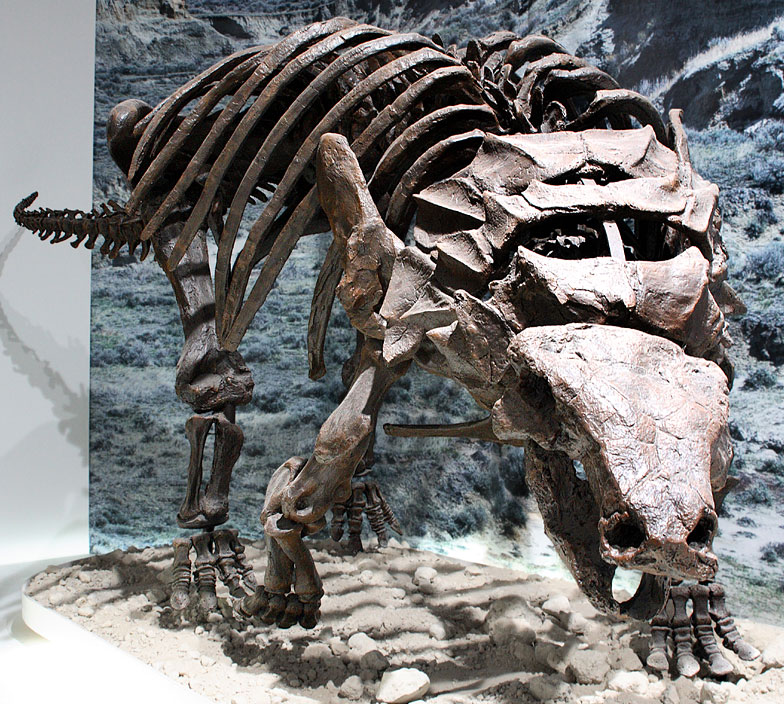
Fundamental revision establishing the classification of Ankylosauria into two families: Ankylosauridae and Nodosauridae. Coombs defines the diagnostic characters separating the two families, including the presence or absence of a tail club and differences in skull and armor morphology. This founding paper is the taxonomic base on which all subsequent nodosaurid research, including Borealopelta, is built. The formal distinction between the two ankylosaur families remains valid today, though subsequent phylogenetic analyses have revealed greater internal complexity in both lineages.


Ankylosauria
Vickaryous, M.K., Maryańska, T. & Weishampel, D.B. · The Dinosauria (2nd edition), University of California Press
Comprehensive reference chapter on Ankylosauria in the second edition of the canonical volume The Dinosauria. Vickaryous, Maryańska and Weishampel review phylogeny, anatomy, ecology, and biogeography of all known ankylosaurs, including all nodosaurids available in 2004. This chapter provides the fundamental taxonomic framework within which Borealopelta was later positioned. The diagnostic characters of Nodosauridae listed in this work form the basis for interpretation of Borealopelta's osteoderms, skull, and posture in 2017.
Systematics, phylogeny and palaeobiogeography of the ankylosaurid dinosaurs
Arbour, V.M. & Currie, P.J. · Journal of Systematic Palaeontology
Comprehensive phylogenetic analysis of Ankylosauria with emphasis on Ankylosauridae. Arbour and Currie include a revised character matrix for Nodosauridae as outgroup, providing the phylogenetic context into which Borealopelta was later inserted. The work clarifies the sister-group relationships between the two major ankylosaur lineages and establishes the synapomorphic characters uniting Ankylosauridae, in contrast to Nodosauridae. The biogeography of ankylosaur diversification throughout the Jurassic and Cretaceous is discussed in detail, with implications for understanding how nodosaurids like Borealopelta reached northern North America in the Albian.
3D camouflage in an ornithischian dinosaur
Vinther, J., Nicholls, R., Lautenschlager, S., Pittman, M., Kaye, T.G., Rayfield, E., Mayr, G. & Cuthill, I.C. · Current Biology
Fundamental methodological paper that developed the technique of chemical analysis of fossil melanins to infer coloration patterns in dinosaurs. Vinther and colleagues apply the method to Psittacosaurus and demonstrate countershading consistent with a forested environment. This same methodological framework was applied by Brown et al. (2017) to reveal the countershaded coloration of Borealopelta markmitchelli. This work is thus the direct technical basis on which the most impactful discovery from the Borealopelta study, the preservation of a coloration pattern, was built.
Phylogeny of the ankylosaurian dinosaurs (Ornithischia: Thyreophora)
Thompson, R.S., Parish, J.C., Maidment, S.C.R. & Barrett, P.M. · Journal of Systematic Palaeontology
Revised phylogenetic analysis of Ankylosauria using 110 characters and 36 taxa. Thompson and colleagues recover Nodosauridae as monophyletic with internal structure consistent with later analyses that placed Borealopelta in a basal position within the family. The work provides the most comprehensive character list for Ankylosauria available before the Borealopelta discovery, representing the state of the art in ankylosaur systematics into which the new Canadian taxon was inserted. The Thompson et al. cladogram was directly used as a starting point for the Brown et al. (2017) phylogenetic analysis.

A new specimen of the ornithischian dinosaur Hesperosaurus mjosi from the Upper Jurassic Morrison Formation of Montana, USA, and a reevaluation of the phylogeny and phylogenetic methods in stegosauria
Maidment, S.C.R., Woodruff, D.C. & Horner, J.R. · The Anatomical Record
Detailed analysis of Thyreophora phylogeny using new morphological data from a Hesperosaurus specimen, clarifying the relationships between Stegosauria and Ankylosauria. Maidment and colleagues' methods provide a methodological template used in subsequent Nodosauridae analyses. The work is relevant to Borealopelta because it precisely defines synapomorphic characters of Thyreophora, clarifying the synapomorphies uniting Ankylosauria and, within this clade, Nodosauridae. The new character scoring approach adopted in this work influenced later phylogenetic matrices.


Spicomellus afer is an ankylosaur (Ornithischia: Thyreophora) and the earliest dinosaur from Africa
Mallon, J.C., Ott, C.J., Larson, P.L., Iuliano, E.M. & Evans, D.C. · Journal of Vertebrate Paleontology
Description of Spicomellus afer as the first ankylosaur from Africa and the oldest dinosaur record from the continent, from the Middle Jurassic of Morocco. Mallon and colleagues contextualize the biogeography of the early radiation of Thyreophora, including the ancestors of Nodosauridae. The identification of ankylosaurs in the Middle Jurassic of Africa implies that group diversification occurred earlier than previously thought, with nodosaurid lineages already established in Pangea before its complete fragmentation. This biogeographical context is relevant to understanding how Borealopelta's precursors reached northern North America in the Albian.


A new horned dinosaur reveals convergent evolution in cranial ornamentation in Ceratopsidae
Brown, C.M. & Henderson, D.M. · Current Biology
Paper by Caleb Brown and Donald Henderson, the same researchers who would describe Borealopelta in 2017, demonstrating the analytical approaches and capabilities of the Royal Tyrrell Museum team. Henderson is the biomechanical modeling and body mass estimation specialist who calculated Borealopelta's weight using three-dimensional volumetric analysis. The work illustrates the Royal Tyrrell Museum's tradition of quantitative paleontology, where the combination of classical descriptive morphology, cladistic phylogenetic analysis, and computational biophysical methods defines the standard of rigor applied to the Borealopelta study.

Espécimes famosos em museus
TMP 2011.033.0001 (holótipo)
Royal Tyrrell Museum of Palaeontology, Drumheller, Alberta
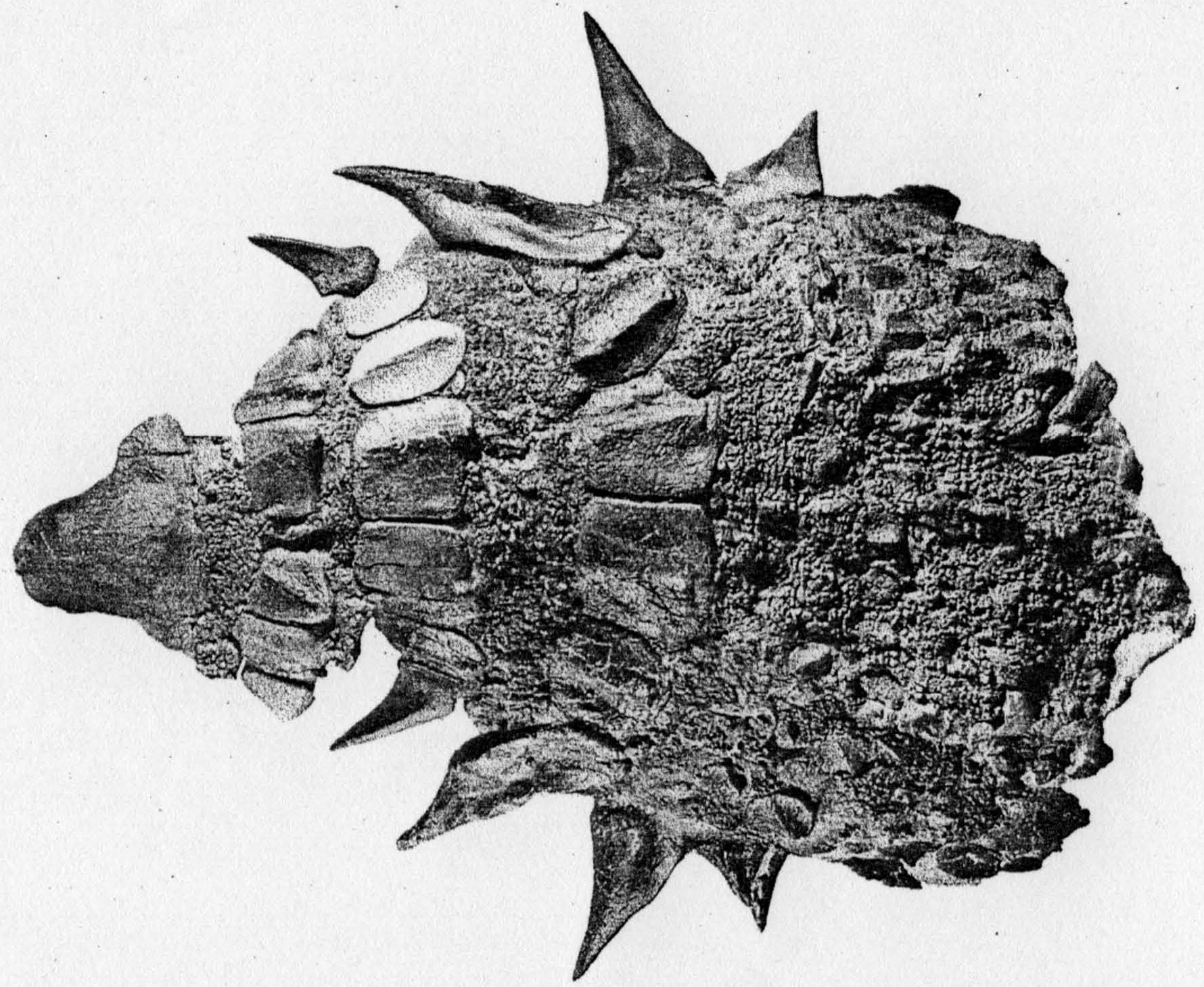
The best-preserved specimen of the species and one of the most exceptional in the dinosaur fossil record. Preserves skin, osteoderms with keratinous sheaths, stomach contents, and organic pigments. It took six years of preparation by Mark Mitchell, whose name the species honors.
TMP 2011.033.0001 (exposição permanente)
Royal Tyrrell Museum of Palaeontology, Drumheller, Alberta
The same holotype has been on permanent display at the Royal Tyrrell Museum since 2017. The exhibit includes an interpretive panel on countershaded coloration, stomach contents, and the six-year preparation process carried out by Mark Mitchell. It is one of the museum's most visited attractions.
In cinema and popular culture
Borealopelta markmitchelli entered popular culture differently from the great carnivorous dinosaurs: not through science fiction, but through journalistic coverage of its extraordinary discovery. When described in 2017, National Geographic called the specimen 'the world's best-preserved dinosaur,' generating global headlines and coverage from BBC, Smithsonian, and dozens of international outlets. In 2020, stomach content analysis again dominated headlines, with Smithsonian Magazine describing Borealopelta as the 'Mona Lisa of dinosaur fossils.' CBC produced the documentary Dinosaur Cold Case following the discovery and preparation of the specimen. The nodosaurid entered entertainment franchises with inclusion in Jurassic World: The Game and Jurassic World Alive in 2023, plus the Mattel Dino Trackers toy line. Despite being an armored herbivore rather than a spectacular carnivore, Borealopelta earned public recognition for offering something few fossils provide: a 112-million-year-old animal that looks like it was preserved yesterday.

Classificação

Descoberta
Curiosidade
Borealopelta markmitchelli is the only dinosaur whose coloration pattern was confirmed by direct chemical analysis of fossilized melanins. The animal had a dark dorsum and lighter underside, a camouflage pattern called countershading, despite weighing 1.3 metric tons and having complete body armor. The species name honors Mark Mitchell, the technician who spent six years manually preparing the fossil.