
Psittacosaurus mongoliensis
Psittacosaurus mongoliensis
"Mongolian parrot lizard"
Sobre esta espécie
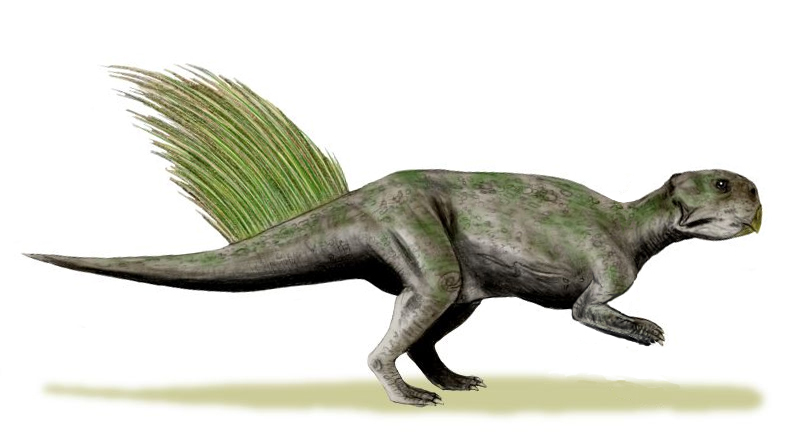
Psittacosaurus mongoliensis is one of the most primitive known ceratopsians and simultaneously the dinosaur represented by the greatest number of individual specimens in the world. It lived during the Early Cretaceous, between 125 and 100 million years ago, in Central Asia. Roughly two meters long and up to 20 kg, it was relatively small: hatchlings were born under 13 cm in length. Its most distinctive feature is the curved, parrot-like horny beak that gave it its name. Rigid bristles on the tail and scales preserved in exceptional specimens provide unique insights into the actual appearance of dinosaurs.
Geological formation & environment
The Yixian Formation in Liaoning Province in northeastern China is one of the world's most important geological formations for Early Cretaceous vertebrate paleontology. Dating to approximately 125 to 120 Ma (Barremian-Aptian), it preserves an extraordinary biota including feathered dinosaurs, primitive birds, nascent flowering plants, and mammals. The exceptional preservation is due to rapid burial by volcaniclastic debris flows (lahars) and lacustrine deposition in a low-oxygen environment. Psittacosaurus mongoliensis is one of the most common dinosaurs of the formation, with specimens from all age ranges.
Image gallery


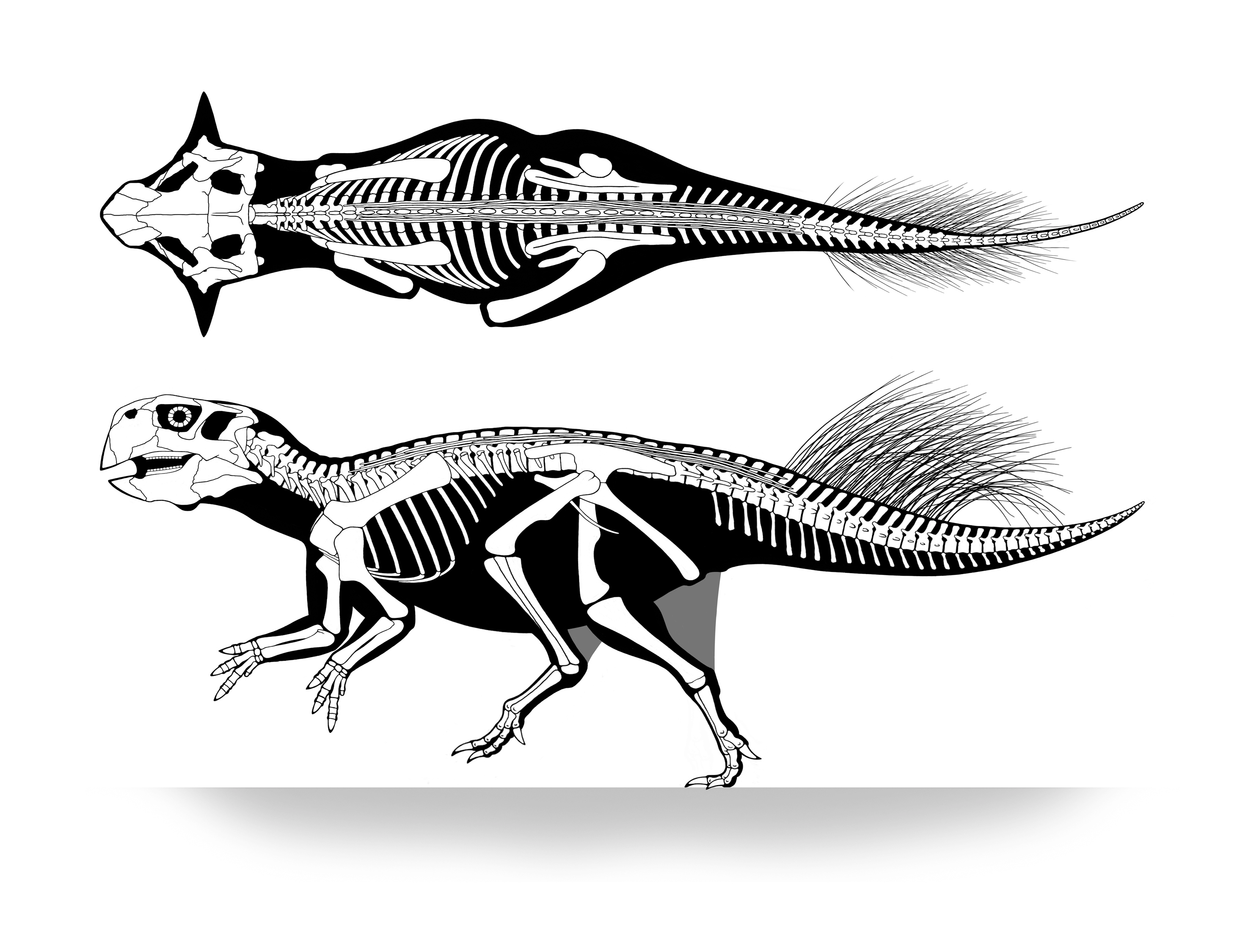



Complete Psittacosaurus sp. (SMF R 4970) fossil at the Senckenberg Museum in Frankfurt: the most important specimen for soft tissue study in dinosaurs, preserving scales, bristles, and color pattern.
Ghedoghedo — CC BY-SA 3.0
Ecology and behavior
Habitat
Psittacosaurus mongoliensis inhabited Early Cretaceous conifer and fern forests of Central Asia, with seasonal humid climate. Analysis of the color pattern of specimen SMF R 4970 indicates forest habitat with diffuse light, where dorsoventral countershading would be effective as camouflage. The Yixian Formation, where many specimens were found, preserves a volcanically active lake surrounded by dense forests, with associated fauna including Repenomamus, primitive birds, and nascent flowering plants.
Feeding
Specialized herbivore feeding on hard vegetation, including seeds, nuts, and high-fiber plant material. The akinetic horny beak, analogous to modern parrots, was adapted for cracking hard-shelled seeds, as demonstrated by Sereno et al. (2009). The abundant gastroliths found in Psittacosaurus specimens functioned as a gastric 'grinding stone' to process difficult-to-digest plant material. The teeth, arranged in compact batteries, produced oblique wear facets through a unique masticatory mechanism combining vertical and horizontal movements.
Behavior and senses
Juvenile Psittacosaurus showed gregarious behavior documented by fossil clusters: groups of 6 to 34 individuals of different ages were buried together by lahar flows in the Lujiatun beds. Adults were obligate bipeds, but hatchlings were quadrupeds, with the postural transition occurring between 4 and 6 years of life, as demonstrated by histological analysis. The countershaded color pattern suggests they lived in forested environments, possibly in small groups for protection against predators such as Repenomamus. The only pathological case documented in the fossil record is an adult with severe bone infection in the fibula that survived the injury.
Physiology and growth
Bone histology of Psittacosaurus mongoliensis reveals a physiology intermediate between reptiles and modern birds: growth rates higher than ectothermic reptiles, but slower than birds and placental mammals. The life cycle was relatively short, with maturity around 10 to 11 years and estimated maximum lifespan of 11 to 12 years. The presence of annual growth lines (LAGs) in bones confirms seasonal growth. The encephalization quotient of 0.31 is comparable to that of Tyrannosaurus, indicating relatively high cognitive capacity for a basal dinosaur. Activity patterns suggest cathemeral behavior, with both diurnal and nocturnal activity.
Paleogeography
Continental configuration

Ron Blakey · CC BY 3.0 · Cretáceous, ~90 Ma
During the Aptiano-Albiano (~125–100 Ma), Psittacosaurus mongoliensis inhabited Laramidia, the western half of present-day North America, separated from the east by the Western Interior Seaway, a shallow sea dividing the continent. The continents were in very different positions: India was drifting toward Asia, Antarctica was still connected to Australia, and South America was an isolated island.
Inventário de Ossos
With hundreds of known specimens covering all life stages from hatchling to adult, the fossil record of P. mongoliensis is exceptionally complete. Specimen SMF R 4970 (Senckenberg, Frankfurt) preserves scales, tail bristles, cloaca, umbilical scar, and color pattern, making it the dinosaur with the most soft tissue preservation ever found.
Found elements
Inferred elements
Scientific Literature
15 papers in chronological order — from the original description to recent research.
Two Lower Cretaceous dinosaurs of Mongolia
Osborn, H.F. · American Museum Novitates
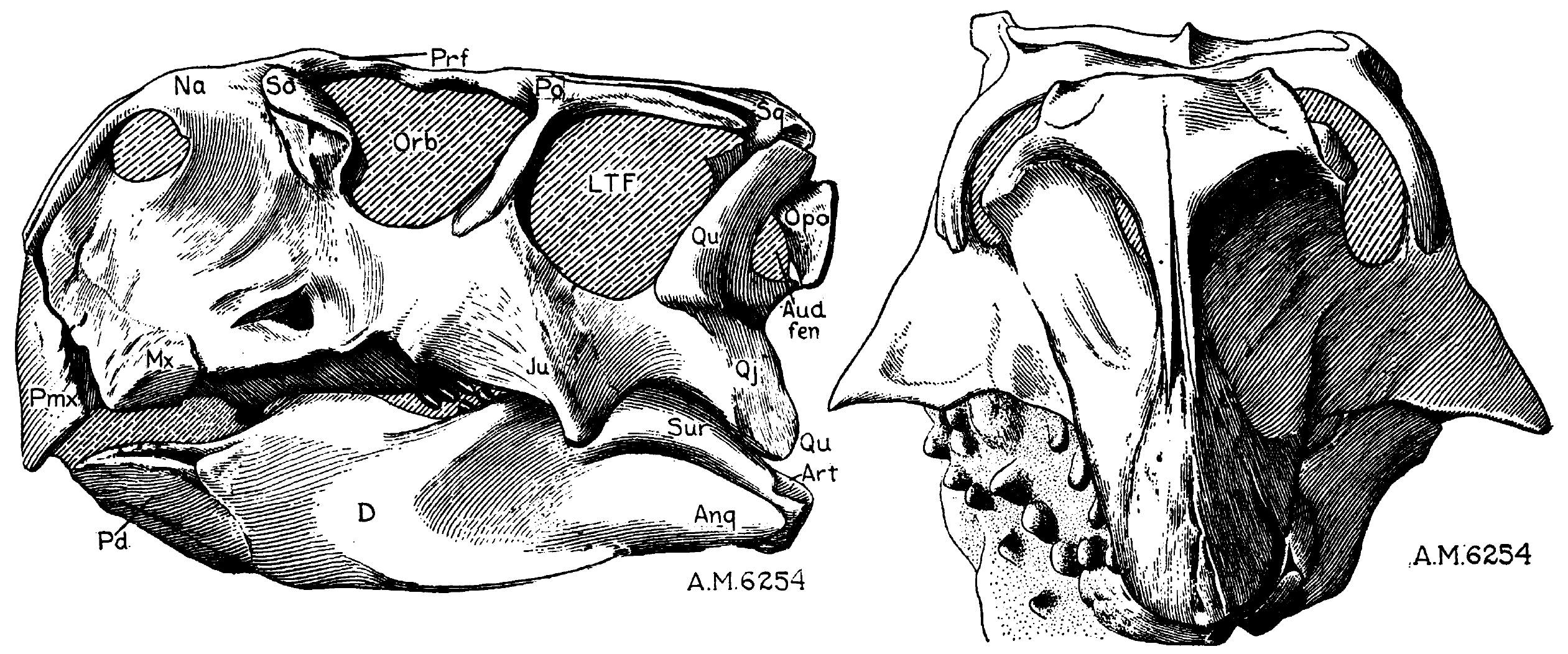
Original description of Psittacosaurus mongoliensis, published in American Museum Novitates based on specimen AMNH 6254, collected by driver Wong during the American Museum of Natural History's Third Asiatic Expedition in 1922, in the Artsa Bogdo Basin of Mongolia. Osborn diagnoses the new genus by its extremely short, deep rostrum, toothless horny beak at the premaxilla, and expanded posterior skull, features reminiscent of a parrot's beak as suggested by paleontologist William King Gregory. The holotype is a nearly complete skull with partial postcranial skeleton, likely a juvenile given its small size. Osborn also describes Protiguanodon mongoliense from a second specimen, a taxonomic relationship revised by Rozhdestvensky in 1955. This paper is the mandatory starting point for all subsequent research on the species.

Psittacosauridae
Sereno, P.C. · The Dinosauria
Comprehensive osteological and phylogenetic review of the family Psittacosauridae, published as a chapter in The Dinosauria, the reference work of dinosaur paleontology edited by Weishampel, Dodson, and Osmólska. Sereno analyzes the diagnostic elements of the group, including the unique rostral bone at the tip of the upper snout, the loss of the fifth phalanx of the hand and the antorbital fenestra, and the tooth morphology lacking grinding capacity. The author positions Psittacosauridae as the most basal ceratopsian group, sister to all other ceratopsians including the Protoceratopsidae and the large horned Ceratopsidae. This phylogenetic analysis provides the foundation for decades of subsequent research on the evolutionary position of the group.

Growth curve of Psittacosaurus mongoliensis Osborn (Ceratopsia: Psittacosauridae) inferred from long bone histology
Erickson, G.M. & Tumanova, T.A. · Zoological Journal of the Linnean Society
Pioneering bone histology study of Psittacosaurus mongoliensis analyzing microstructure of axial and appendicular skeletal elements across the entire ontogeny, from hatchling to adult. Erickson and Tumanova apply the Developmental Mass Extrapolation (DME) method to reconstruct, for the first time, a complete growth curve for a dinosaur based on counting annual growth lines (LAGs). The result reveals an S-shaped curve, with slow growth in the hatchling phase, maximum acceleration between 2 and 4 years of life, and deceleration in the adult phase. Maximum growth rates are higher than in modern reptiles and marsupials, but lower than in birds and eutherian mammals, suggesting an intermediate physiology. The smallest specimen studied is 3 years old and under 1 kg; the largest is 9 years old and nearly 20 kg. This paper establishes P. mongoliensis as a reference model for growth studies in dinosaurs.
A new psittacosaur from Inner Mongolia and the parrot-like structure and function of the psittacosaur skull
Sereno, P.C., Zhao, X. & Tan, L. · Proceedings of the Royal Society B: Biological Sciences
Study describing Psittacosaurus gobiensis, a new species from Inner Mongolia, and using functional comparison with modern parrots to elucidate the unique masticatory mechanism of psittacosaurids. Sereno, Zhao, and Tan demonstrate that the akinetic skull of psittacosaurids, where both the cranium and the lower jaws are rigid, produced oblique tooth wear facets through an isognathous mechanism combining vertical and propalinal (horizontal) jaw movements. The differentiated adductor jaw musculature is compared to that of psittaciform birds (parrots), a remarkable evolutionary convergence. The large gastroliths found in Psittacosaurus specimens indicate a diet of hard seeds and nuts, consistent with the inferred shell-cracking function of the beak. The work redefined the understanding of feeding ecology for the entire group.

3D Camouflage in an Ornithischian Dinosaur
Vinther, J. et al. · Current Biology
Revolutionary study using the Frankfurt specimen (SMF R 4970) of Psittacosaurus to reconstruct, for the first time, the complete 3D color pattern of a non-avian dinosaur. Vinther and colleagues analyzed melanosomes preserved in the specimen's integument via scanning microscopy and computer modeling, building a life-size three-dimensional replica. The result shows countershaded coloration: dark dorsum, pale underside, disruptive markings on the limbs, and pigment concentrations on the face and shoulders, possibly with display function. The 3D model was tested under different lighting conditions, and the pattern corresponds to camouflage of animals living in dense forests with diffuse light. The work established that it is possible to infer dinosaur habitat from preserved coloration analysis.
Structure and homology of Psittacosaurus tail bristles
Mayr, G. et al. · Palaeontology
Study examining the tail bristles of the Psittacosaurus specimen SMF R 4970 using laser-stimulated fluorescence (LSF) imaging, revealing unprecedented structural details. The bristles, up to 16 cm long, are organized in bundles and show an internal pulp widening toward the base, detected as a bright fluorescent stripe. The authors conclude that the bristles are structurally and developmentally homologous to similar filamentous appendages in other ornithischian dinosaurs, such as Tianyulong and the basal theropod Beipiaosaurus, suggesting a shared evolutionary origin for these filamentous structures among phylogenetically distantly related dinosaurs. The greater robustness of Psittacosaurus bristles is attributed to a higher degree of cornification and calcification of the integument. The study is fundamental to the debate on the evolutionary origin of feathers.

Histology and postural change during the growth of the ceratopsian dinosaur Psittacosaurus lujiatunensis
Zhao, Q. et al. · Nature Communications
Work combining histological analysis of long bones with measurements of fore and hind limbs to document one of the most remarkable behavioral changes in paleontology history: the ontogenetic transition from quadrupedalism to bipedalism in Psittacosaurus. The authors demonstrate that the forelimb is strongly negatively allometric relative to the hindlimb: born with similar proportions, it grows more slowly, becoming only 58% of hindlimb length in the adult. Histology confirms this proportional change is accompanied by increased growth rate in the hindlimb during the first and second years of life, with the postural change inferred around 4 to 6 years. Juveniles were quadrupeds; adults were obligate bipeds. The evolutionary implication is even broader: ontogenetic postural shifts may have been the ancestral condition for the entire dinosaur group.

Juvenile-Only Clusters and Behaviour of the Early Cretaceous Dinosaur Psittacosaurus
Zhao, Q. et al. · Acta Palaeontologica Polonica
Study reassessing evidence for social behavior and parental care in Psittacosaurus, focusing on the controversial specimen DNHM D2156 with 34 juveniles and a supposed adult. Zhao and colleagues demonstrate that the 'adult' skull was glued onto the original specimen and, even if it were part of it, corresponds to an individual below reproductive age. What was interpreted as a brood cared for by an adult is therefore an artificial composite. Nevertheless, the authors identify authentic juvenile-only clusters in the Lujiatun beds, buried by pyroclastic flows, preserving groups with different histological ages, such as five 2-year-old individuals and one 3-year-old. These clusters indicate genuine gregarious behavior among Psittacosaurus juveniles, possibly for protection or collaborative foraging, without evidence of direct parental care.

The osteology and taphonomy of a Psittacosaurus bonebed assemblage of the Yixian Formation (Lower Cretaceous), Liaoning, China
Hedrick, B.P. et al. · Cretaceous Research
First detailed osteological study of the Psittacosaurus juvenile cluster DMNH D2156 from the Yixian Formation, Liaoning, China, combining anatomical description, allometric analysis, and mineralogical investigation. Hedrick and colleagues demonstrate that the specimens are post-hatchlings rather than embryos, with allometric analysis indicating that most skeletal elements grew isometrically with body size, except the forelimbs, which grew more slowly. Mineralogical investigation reveals the specimens were preserved in volcanic-lithic material, supporting a lahar flow interpretation for the exceptional preservation of the entire Yixian biota, including feathered and soft-tissue specimens. The paper provides the primary anatomical reference for Yixian Formation Psittacosaurus juveniles and is essential for interpreting juvenile aggregation behavior in the species.

The Psittacosaurus biochron, Early Cretaceous of Asia
Lucas, S.G. · Cretaceous Research
Biostratigraphic study using the broad geographic and temporal distribution of Psittacosaurus to define the 'Psittacosaurus biochron', a biostratigraphic time interval for the Early Cretaceous of Asia. Lucas correlates all known Psittacosaurus records in Russia (Western Siberia), Mongolia, China (Liaoning, Nei Monggol, Gansu, Ningxia, Xinjiang, Shandong, Hebei), Thailand, and possibly Japan to the global chronostratigraphic system via radioisotopic dates and palynology. The biochron equates to the Tsagantsabian (Barremian-early Aptian) and Khukhtekian (late Aptian-Albian) Land Vertebrate Faunachrons, spanning approximately 20 million years. The vast geographic distribution and long temporal duration make Psittacosaurus one of the most useful index fossils for biostratigraphic correlation in the Cretaceous of Asia.

A New Taxon of Basal Ceratopsian from China and the Early Evolution of Ceratopsia
Han, F. et al. · PLOS ONE
Paper describing Hualianceratops wucaiwanensis, a new basal ceratopsian from the Upper Jurassic of China, and presenting a comprehensive phylogenetic analysis of Ceratopsia. Han and colleagues' analysis tests the placement of Psittacosauridae within Ceratopsia relative to Chaoyangsauridae and Neoceratopsia. The result weakly supports a Psittacosaurus + Chaoyangsauridae clade as the sister group of Neoceratopsia, removing chaoyangsaurids from Neoceratopsia. The discovery of multiple ceratopsian lineages already in the Late Jurassic significantly increases the group's origin age, with implications for understanding the evolution of the rostral bone and other Ceratopsia synapomorphies. For P. mongoliensis specifically, the work refines its basal position within the group as one of the most primitive ceratopsians known.


The integument of Psittacosaurus from Liaoning Province, China: taphonomy, epidermal patterns and color of a ceratopsian dinosaur
Lingham-Soliar, T. & Plodowski, G. · Naturwissenschaften
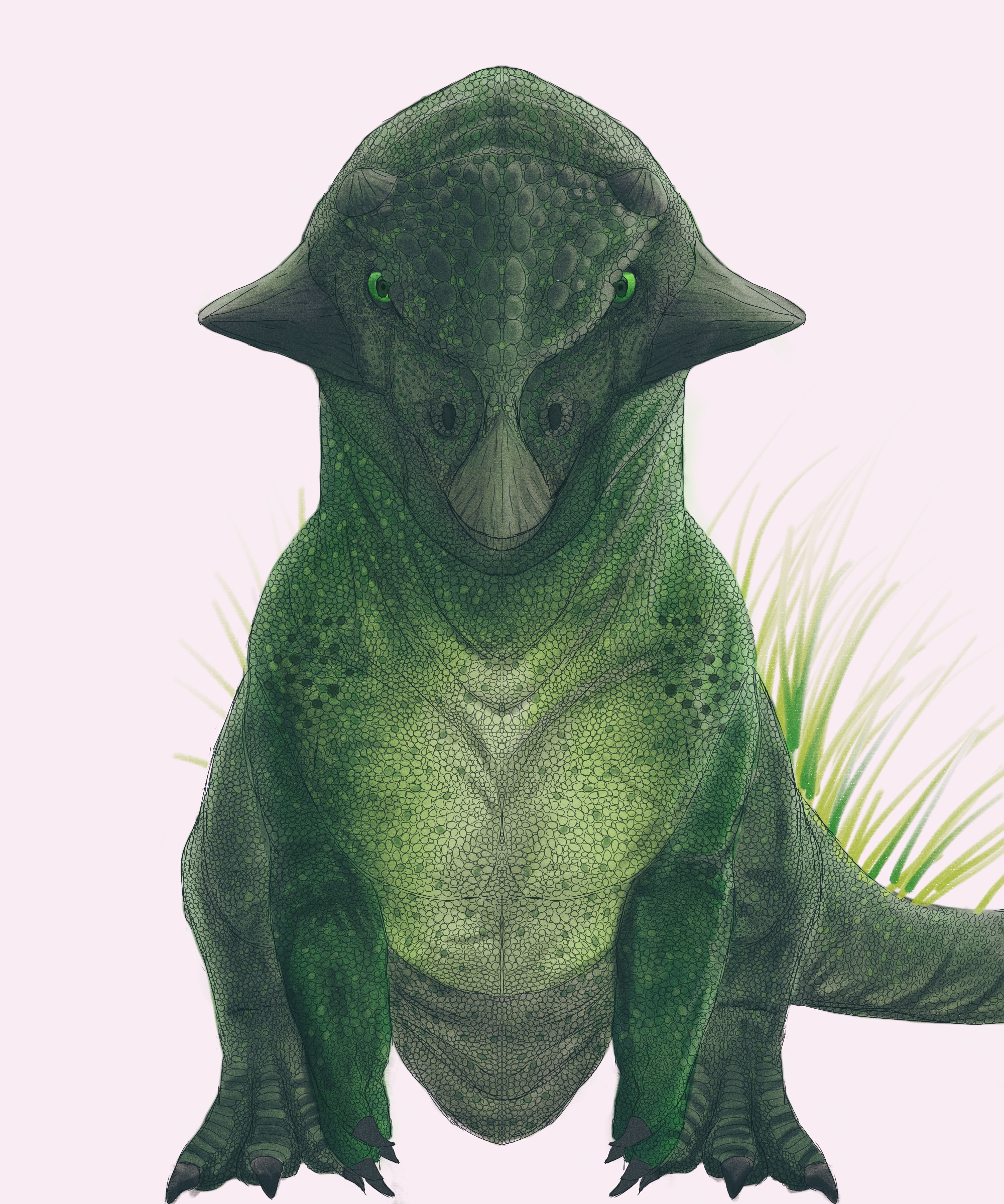
First systematic study of preserved scales from Psittacosaurus from Liaoning, identifying three distinct types: large plate-like scales, smaller polygonal scales or tubercles, and rounded pebble-like scales. Lingham-Soliar and Plodowski document cryptic light and dark patterns created by the association between plate-like scales and tubercles, as well as evidence of countershading in the proximal caudal region, with the body darker dorsally and lighter ventrally. The authors propose that melanin was the dominant pigment in Psittacosaurus coloration, reconstructing colors predominantly as black and amber-brown in cryptic patterns. This work anticipated by 6 years the conclusions of Vinther et al. (2016) on countershading, being the first fossil-based evidence of coloration in a ceratopsian.

Oldest preserved umbilical scar reveals dinosaurs had 'belly buttons'
Bell, P.R. et al. · BMC Biology
Extraordinary discovery published in BMC Biology: the Frankfurt specimen of Psittacosaurus (SMF R 4970) preserves the oldest umbilical scar ever found in a fossil amniote, approximately 130 million years old. Bell and colleagues use laser-stimulated fluorescence (LSF) to reveal an elongated midline abdominal structure delimited by a row of paired scales, corresponding to the umbilical scar, the equivalent of a belly button in mammals. The structure is distinct from surrounding scales and has no analog in modern adult reptiles, but is comparable to the transient umbilical scar of crocodilian and some lizard hatchlings. The same specimen also preserves the cloaca, revealing anatomy similar to crocodilians. The work changed public perception of dinosaur anatomy and generated wide coverage in international scientific media.


The exquisitely preserved integument of Psittacosaurus and the scaly skin of ceratopsian dinosaurs
Bell, P.R. et al. · Communications Biology
Comprehensive study of the integument of the Frankfurt specimen of Psittacosaurus using laser-stimulated fluorescence, revealing unprecedented complexity in the animal's scales. Bell and colleagues identify marked regional variation in scale morphology: truncated cone-shaped scales on the shoulders, longitudinal rows of quadrangular scales on the tail, and unique patterns in other regions. The cloaca shows a longitudinal slit, a pattern found only in crocodilians among modern tetrapods, suggesting similar internal anatomy. A comprehensive review of ceratopsian integument demonstrates that scalation was conservative throughout the evolution of the group. The Frankfurt specimen preserves the highest percentage of body covering and the best-preserved scales of any dinosaur, central to understanding dinosaur appearance and biology.


Biomechanical Evaluation of Different Musculoskeletal Arrangements in Psittacosaurus and Implications for Cranial Function
Taylor, A.C. et al. · The Anatomical Record
Cranial biomechanics study of Psittacosaurus using computed tomography, digital restoration of cranial anatomy and adductor musculature, and finite element analysis to test how different muscular arrangements influence stress, deformation, and bite forces in the skull. Taylor and colleagues test the inclusion or exclusion of two additional muscles (m. pseudomasseter and m. AMEV) in bite force estimates. Results show these muscles increase bite force with an associated increase in cranial stress and deformation, but there is limited osteological evidence for their existence in psittacosaurid skulls. Bite position has a greater effect on loading patterns than muscular composition or material property variation. The study confirms the specialized bite capacity of Psittacosaurus for hard foods such as seeds and nuts.

Espécimes famosos em museus
AMNH FARB 6254 (Holótipo)
American Museum of Natural History, Nova York, EUA
Original type specimen of Psittacosaurus mongoliensis, collected during the AMNH Third Asiatic Expedition in 1922 in the Artsa Bogdo Basin, Mongolia. Osborn described it in 1923 based primarily on the nearly complete skull.
SMF R 4970
Senckenberg Naturmuseum, Frankfurt, Alemanha
The most important specimen in the history of dinosaur paleontology in terms of soft tissue preservation. It preserves scales over nearly the entire body, tail bristles up to 16 cm long, cloaca with longitudinal slit, umbilical scar, and complete color pattern. It is on permanent public display at the Senckenberg.
IVPP V14341
Institute of Vertebrate Paleontology and Paleoanthropology, Pequim, China
Cluster of six juvenile Psittacosaurus mongoliensis buried together by lahar flow in the Lujiatun beds, Liaoning. Histological analysis revealed that the six individuals were of different ages, evidence of gregarious behavior among juveniles.
In cinema and popular culture
Psittacosaurus mongoliensis had a discreet but growing trajectory in popular culture. Its first recorded appearance was in Disney's Fantasia (1940), where it appeared briefly in the 'Rite of Spring' sequence, with a representation very far from what science would know decades later. During the dinosaur boom of the 1990s and 2000s, Psittacosaurus remained on the margins of Hollywood mainstream, eclipsed by larger ceratopsians like Triceratops. Its biggest appearance in a blockbuster came in Transformers: Age of Extinction (2014), where Michael Bay included a Psittacosaurus in the Cretaceous opening scene, with the rare distinction of depicting the tail bristles discovered in 2002. In games, the species gained growing prominence: it appears in the simulator Prehistoric Kingdom (2022), with coloration based on the scientific data of Vinther et al. (2016), and in Jurassic World Evolution 3 (2024), its inclusion in the Jurassic World franchise represents the definitive recognition of the dinosaur as a pop culture character. The growing scientific interest in the species, especially after the series of discoveries on the Frankfurt specimen, made Psittacosaurus a favorite of paleontologists and science communicators, ensuring a constant presence in documentaries and scientific media.

Classificação

Descoberta
Curiosidade
Psittacosaurus mongoliensis is the dinosaur represented by the greatest number of known individual specimens in the world: hundreds of fossils have been recovered, including nearly 20 complete skeletons with skulls. It is also the only dinosaur whose 'belly button' has been found: specimen SMF R 4970 at the Senckenberg Museum in Frankfurt preserves a 130-million-year-old umbilical scar, revealed by laser fluorescence in 2022.